



Two professors from Mansoura University appointed to the Standing Committees for Egyptian, Greek, and Roman Antiquities, and for Islamic, Coptic, and Jewish Antiquities
- Hits: 179
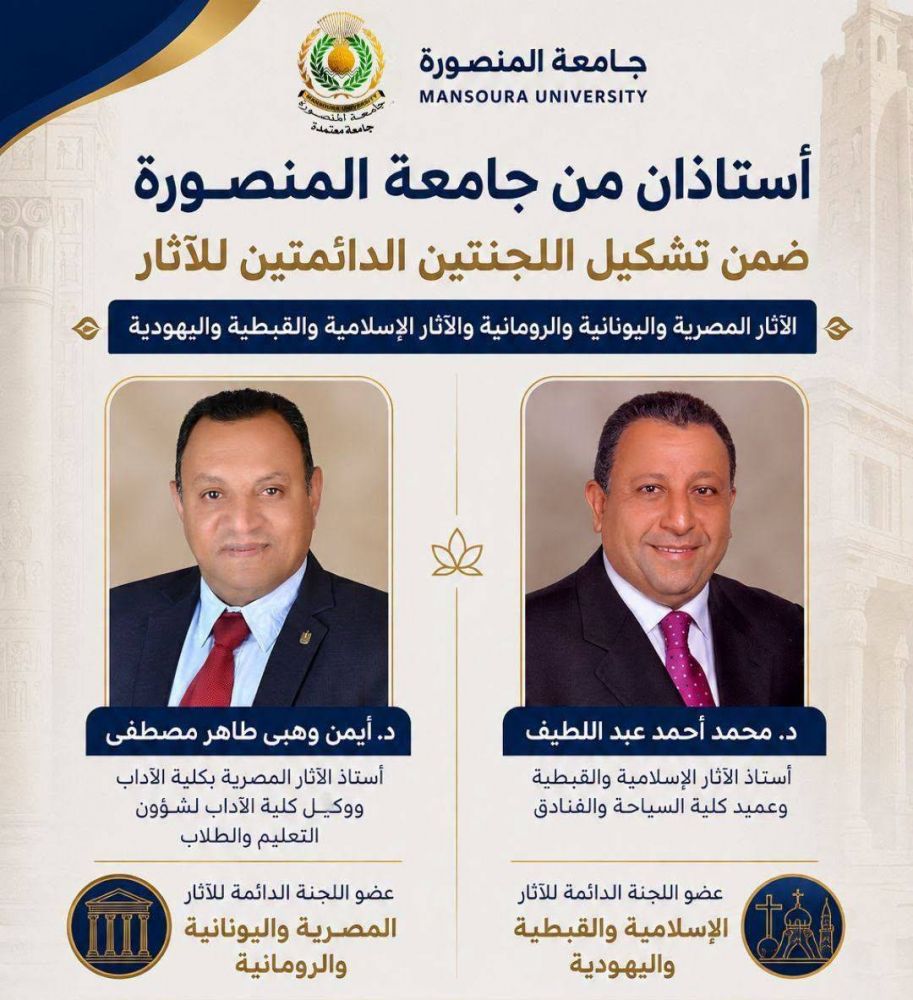
Prof. Cherif Khater: The participation of university scholars in specialized committees reflects the role of academic expertise in supporting archaeological work and preserving Egyptian heritage
Prof. Cherif Khater, President of Mansoura University, congratulated Prof. Mohamed Ahmed Abdel Latif, Professor of Islamic and Coptic Archaeology and Dean of the Faculty of Tourism and Hotels at Mansoura University, and Prof. Ayman Wahbi Taher Mustafa, Professor of Egyptian Archaeology at the Faculty of Arts and Vice Dean for Education and Student Affairs, on their appointment to the Standing Committees for Islamic, Coptic, and Jewish Antiquities, and for Egyptian, Greek, and Roman Antiquities at the Supreme Council of Antiquities, in accordance with the decision of Mr. Sherif Fathy, Minister of Tourism and Antiquities, to reconstitute the two committees. The selection of Prof. Mohamed Ahmed Abdel Latif to the Permanent Committee for Islamic, Coptic, and Jewish Antiquities, and Prof. Ayman Wahbi Taher Mustafa to the Permanent Committee for Egyptian, Greek, and Roman Antiquities, are part of the newly formed committees. These committees include a number of specialists in archaeology and related fields, along with faculty members from Egyptian public universities and experts in urban planning.
Prof. Cherif Khater emphasized that this selection reflects confidence in their scientific expertise and academic specializations. He noted that the participation of university faculty members in national and specialized committees underscores the importance of utilizing scientific and research expertise to serve the nation and society, and to support efforts to preserve Egyptian heritage.
The university president explained that the diversity of expertise and specializations represented in the new committees supports the integration of scientific, technical, and academic perspectives related to archaeological work. This enhances the utilization of specialized expertise in studying archaeological issues, providing opinions on them, and making necessary decisions. Minister of Tourism and Antiquities, Sherif Fathy, issued two ministerial decrees reconstituting the Permanent Committee for Islamic, Coptic, and Jewish Antiquities, and the Permanent Committee for Egyptian, Greek, and Roman Antiquities, both of which were formed in 2018. This reconstitution reflects the Ministry's commitment to continuously developing the archaeological work system, enhancing the efficiency of the permanent antiquities committees, and raising their standards.
The reconstitution of these committees stems from their crucial role in studying and researching archaeological matters, providing opinions on them, and making necessary decisions. This contributes to improving the operational mechanisms of the Supreme Council of Antiquities, supporting efforts to preserve Egyptian antiquities of all types, and contributing to the completion of national projects in cooperation with various state entities.
The new formation aims to inject fresh perspectives and expertise into the work of both committees by drawing on a group of experienced and qualified individuals from within the Ministry and its affiliated bodies, as well as from external organizations. This ensures a diversity of experience and scientific, technical, and academic specializations relevant to archaeological work. This will enrich the discussions of the two committees and enhance the quality of their decisions.
The two committees were formed under the chairmanship of Prof. Hisham El-Leithy, Secretary-General of the Supreme Council of Antiquities, and include the heads of the relevant sectors within the Council, several heads of related central and general departments, representatives from the Grand Egyptian Museum Authority, the National Museum of Egyptian Civilization, and the Tourism and Antiquities Support Fund, as well as a number of specialists in archaeology and related fields, faculty members from Egyptian public universities, and experts in urban planning.


